
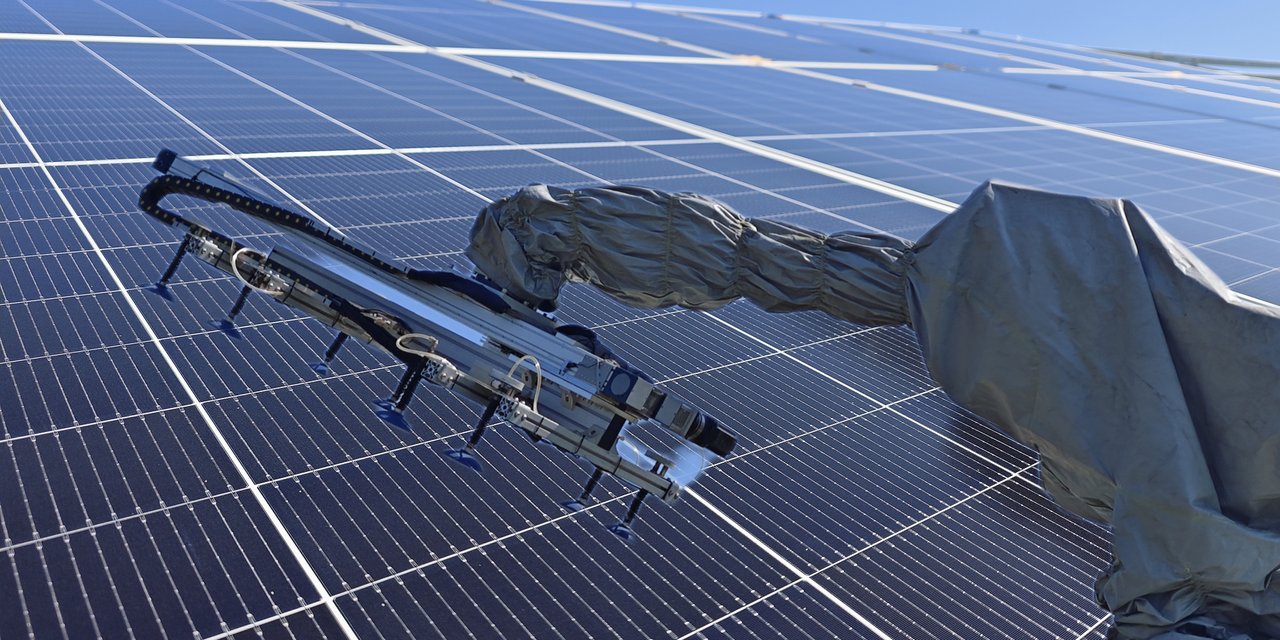
Most utility-scale solar projects are not built on perfectly flat ground.
Ground-mounted PV sites can include slopes, uneven terrain, ground undulation, changing elevations, and variations in mounting structures. For solar panel installation robots, this creates a fundamental challenge:
Can a robot maintain stability and install modules accurately when the site itself is not perfectly flat?
The answer depends less on the robot's ability to simply drive uphill and more on its ability to perceive, adapt, and accurately place modules in changing outdoor conditions.
Flat Terrain vs. Sloped Terrain
On flat terrain, robotic PV module installation is relatively straightforward. The robot can move along a predictable path while maintaining a consistent relationship with the mounting structure.
Sloped and uneven terrain introduces additional variables:
- Changes in ground elevation
- Different approach angles
- Robot body inclination
- Ground undulation
- Bracket deviation
- Variable module height
- Outdoor lighting and shadows
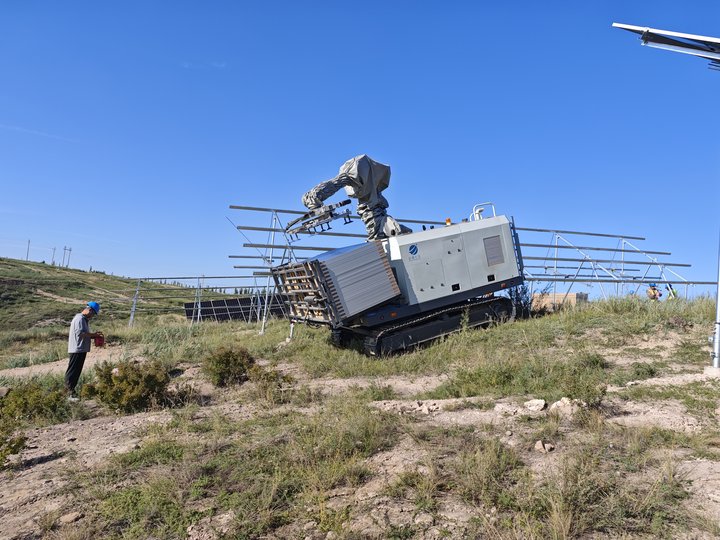
This means a solar installation robot needs more than mechanical movement. It needs real-time environmental perception and positioning capabilities.
1.Terrain Perception
Before placing a PV module, the robot needs to understand its surroundings.
3D perception can help identify the relative position of the robot, mounting structure, module and surrounding terrain.
Instead of relying only on predefined coordinates, the robot can use spatial information to continuously understand the working environment.
This becomes particularly important when the actual site conditions differ from the original construction drawings.
2. 3D Vision for Precise Positioning
Uneven terrain can change the relative position between the robot and the mounting structure.
A vision-based system can detect the actual position and orientation of the target installation area.
For robotic PV module installation, this can support several key tasks:
- Detecting mounting structures
- Identifying module placement areas
- Measuring relative position and angle
- Compensating for positioning deviations
- Guiding the module into the correct installation position
In other words, the robot does not simply follow a fixed path. It needs to continuously perceive and adjust.
3.Robot Stability on Slopes
Slope creates another challenge: stability.
A robot working on uneven ground needs to maintain a stable operating posture while moving and handling a large PV module.
This requires coordination between the mobility system, mechanical structure and control algorithms.
The objective is not simply to climb a slope, but to maintain sufficient stability throughout the complete process:
driving → approaching → lifting → positioning → placing.
4. Module Positioning and Bracket Deviation
The terrain is only one part of the problem.
Even when the robot reaches the correct location, the mounting structure may have small deviations from the theoretical design position.
A practical installation robot therefore needs to account for both:
terrain variation + installation structure variation.
With 3D vision and positioning algorithms, the robot can identify the actual target position before placing the module.
This helps reduce dependence on perfectly standardized site conditions.
5. Outdoor Lighting Conditions
Outdoor solar construction sites also create challenging visual conditions.
Strong sunlight, shadows, reflections and changing illumination can affect machine vision systems.
For this reason, robotic PV installation requires perception systems designed for real outdoor environments—not only controlled factory environments.
Reliable perception is particularly important when the robot needs to identify structures and module positions under changing lighting conditions.
6. Human-Machine Collaboration
Complex terrain does not necessarily mean that the entire installation process must be fully autonomous.
A practical approach is human-machine collaboration.
For example, an operator can define the working area and driving direction, while the robot handles repetitive tasks such as:
- Module grasping
- 3D positioning
- Attitude adjustment
- Precise alignment
- Buffered module placement
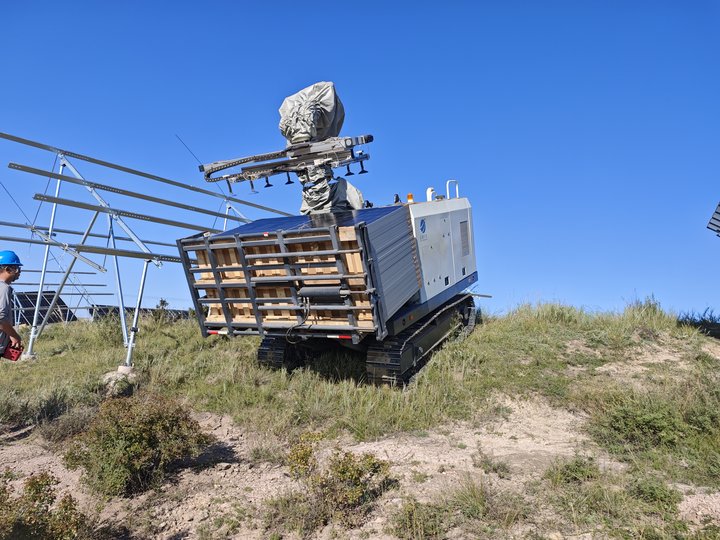
This approach allows the robot to handle repetitive and physically demanding work while operators remain available for temporary or unexpected site conditions.
Real-World Field Test: Robotic PV Module Installation on a 20° Slope
Laboratory testing is useful, but real construction sites are the real test.
In field testing, RELU's Bison PV module installation robot has been operated on terrain with a slope of approximately 20°, demonstrating robotic module installation under non-flat outdoor conditions.
The test focused on the complete installation workflow rather than simply robot mobility:
terrain navigation → module handling → visual positioning → attitude adjustment → module placement.
This type of field validation is important because utility-scale solar projects rarely provide perfectly controlled working environments.
The key question for EPC contractors is therefore not simply:
“Can a robot work on flat ground?”
It is:
“Can the robot adapt to the actual conditions of my project?”
What Should EPC Contractors Check Before Deployment?
Before introducing a solar panel installation robot to a project, several site parameters should be evaluated:
- Maximum terrain slope
- Ground surface conditions
- Row spacing
- Mounting structure configuration
- Module dimensions and weight
- Module height from the ground
- Bracket positioning tolerance
- Access road width
- Working area and turning space
These parameters help determine whether a robotic installation solution can be integrated into the project without major site modifications.
Final Takeaway
Sloped and uneven terrain does not automatically prevent robotic PV module installation.
The real challenge is whether the robot can perceive changing terrain, maintain stability, understand the actual mounting structure and accurately position each module.
For utility-scale solar construction, this is where technologies such as 3D vision, terrain perception, positioning algorithms and human-machine collaboration become critical.
As solar projects move into increasingly diverse and challenging environments, the future of robotic PV installation will depend not only on speed—but also on how well robots can adapt to the real world.
Be the first to comment.