
From Desert Labor Challenges to Intelligent Solar Construction
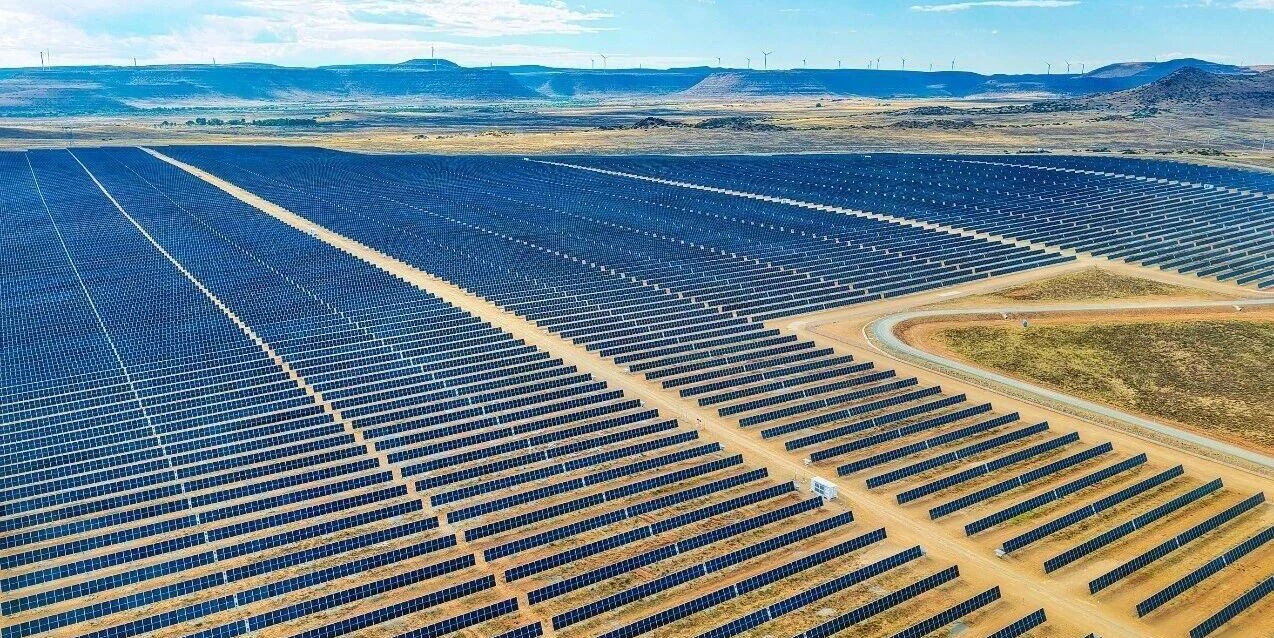
Deep in the desert or remote Gobi regions, a massive solar farm construction scene is common:
Under extreme sunlight, hundreds or even thousands of workers repeatedly bend down, lift heavy modules, align panels, and fasten components thousands of times every day.
A single photovoltaic module may weigh 20–40 kilograms.
After thousands of installation cycles, physical fatigue becomes unavoidable. Worker safety risks increase, installation efficiency fluctuates, and project schedules become harder to control.
For large-scale solar power projects, three challenges consistently define construction success:
Efficiency. Cost. Safety.
These are the biggest pain points facing global utility-scale solar developers and EPC contractors.
Now, a new generation of solar panel installation robots is changing this equation.
It is not simply an automated machine replacing manual labor.
It is an embodied AI robot designed for precision operations in unstructured outdoor environments ,a new form of intelligent productivity for the future of solar construction.
What Does “Embodied AI for Solar Construction” Really Mean?
The concept of an “embodied intelligence foundation for fine operations in unstructured environments” may sound complex, but the idea is straightforward:
A robot must be able to:
- Understand its environment
- Make intelligent decisions
- Execute precise physical tasks
- Continuously improve through real-world experience
Unlike traditional industrial robots that operate inside controlled factories, outdoor construction robots must work in environments where conditions constantly change.
This is the core challenge of Physical AI.
The Challenge: Solar Farms Are Not Factories
Traditional industrial robots succeed because factories provide:
- Flat and predictable floors
- Stable lighting conditions
- Standardized components
- Fixed workflows
However, utility-scale solar farms are completely different.
A solar installation robot working outdoors must handle:
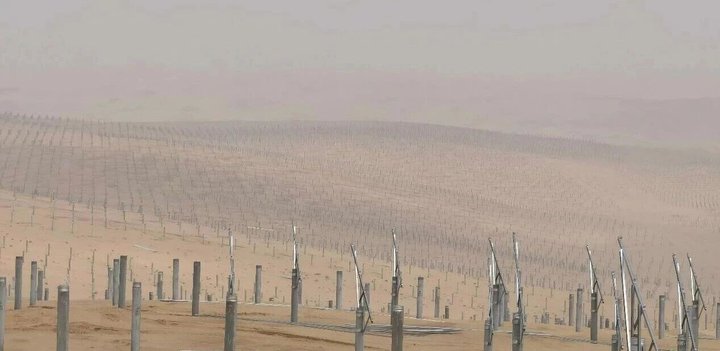
- Unstructured Terrain
Solar farms are often built in:
- Deserts
- Gobi regions
- Mountains
- Remote areas
Ground conditions can vary significantly.
The robot must adapt to:
- Uneven terrain
- Slopes
- Changing ground elevation
- Different installation environments
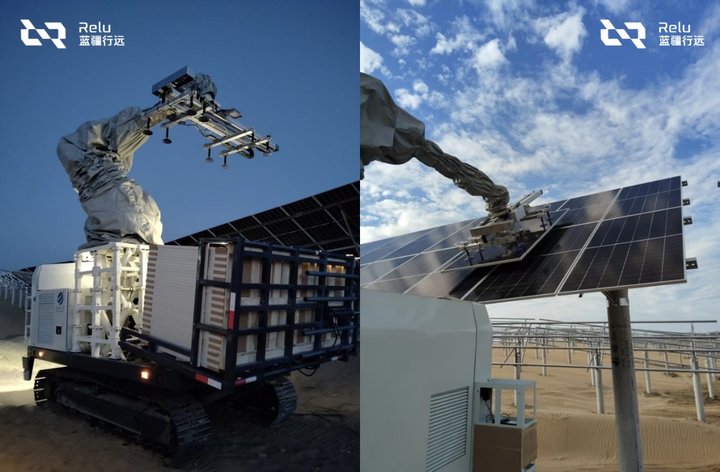
Relu Robotics’ Bison PV Module Laying Robot is designed for challenging outdoor construction scenarios, supporting operation in complex environments where traditional automation solutions struggle.
2. Unstructured Environmental Conditions
Outdoor solar construction faces extreme conditions:
- Strong sunlight exceeding 100,000 lux
- Dust and sand
- Temperature fluctuations from -20°C to +60°C
- Wind and weather changes
For a robot, the biggest challenge is not movement.
It is perception.
A solar installation robot must accurately understand its surroundings despite constantly changing environmental conditions.
The Core Technology Behind Solar Installation Robots: See, Understand, and Act
A true AI-powered solar construction robot requires three fundamental capabilities:
- Seeing: High-Precision 3D Perception
Installing a photovoltaic module is not simply placing a panel on a rack.
The robot must recognize:
- Module position
- Mounting structure location
- Connector alignment
- Installation angle
- Small deviations caused by construction conditions
Relu Robotics’ self-developed 3D perception system enables:
- Millimeter-level environmental perception
- Strong-light interference resistance
- Accurate bracket and module recognition
With perception accuracy below 3 mm and angle recognition error below 0.5°, the robot can continue operating even under harsh outdoor lighting conditions.
2. Grasping: Flexible Control Instead of Rigid Automation
A photovoltaic module is a precision component.
Excessive force can cause:
- Micro-cracks
- Hidden damage
- Reduced power generation performance
Traditional automation relies on fixed movements.
Outdoor construction requires something different:
Adaptive and flexible control.
Through force feedback and intelligent motion control, the robot adjusts its movement dynamically , similar to how a human worker naturally changes strength and position when handling fragile objects.
The result:
- More stable handling
- Lower module damage risk
- Consistent installation quality
3. Placing: Precision Installation with Human-Robot Collaboration
The future of solar construction is not about removing humans from the process.
It is about creating human-machine collaboration.
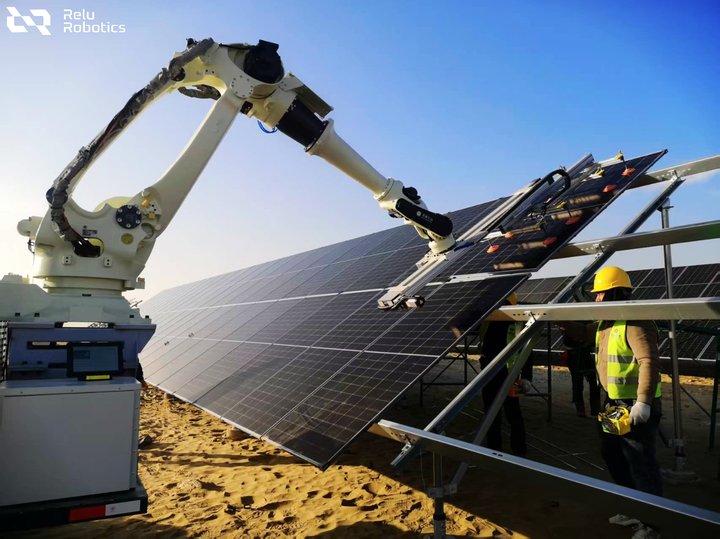
Today’s solar installation robots combine:
- Human supervision
- Autonomous perception
- Intelligent handling
- Automated placement
In practical solar farm scenarios, the Bison PV Module Laying Robot can achieve approximately:
80 modules per hour in 2P fixed-tilt installation scenarios
While significantly reducing repetitive manual labor requirements.
The goal is not simply replacing workers.
The goal is:
Let humans manage intelligent construction systems instead of performing thousands of physically demanding repetitive actions.
Many AI systems today operate inside computers.
They process:
- Text
- Images
- Data
But physical AI robots interact directly with the real world.
They must deal with:
- Gravity
- Friction
- Material deformation
- Mechanical force
- Environmental uncertainty
There is no “undo button” in the physical world.
A solar construction robot must make decisions instantly and safely while interacting with real materials in real environments.
This is why outdoor embodied intelligence is one of the most challenging areas in robotics.
Beyond Automation: Building the Future of Solar Construction
The global solar industry is entering a new phase.
Projects are becoming:
- Larger
- More remote
- More complex
- More demanding in construction speed
Traditional labor-intensive installation methods face increasing pressure from:
- Labor shortages
- Rising construction costs
- Tight project schedules
- Quality control requirements
Solar installation robots and embodied AI technologies provide a new solution.
They enable:
✓ Faster solar module installation
✓ More consistent construction quality
✓ Reduced dependence on manual labor
✓ Improved worker safety
✓ Scalable deployment for large solar farms
Relu Robotics: Building the Embodied AI Foundation for Outdoor Solar Construction
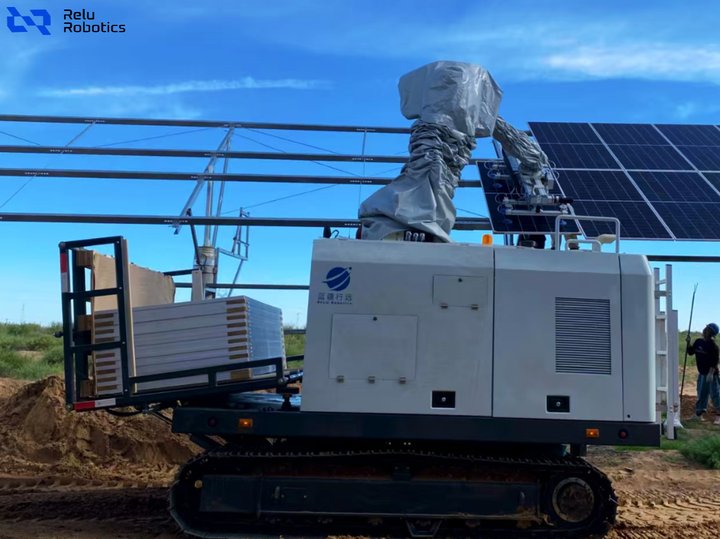
Relu Robotics is developing intelligent robotic systems designed specifically for real-world outdoor environments.
The Bison Series PV Module Laying Robot is the company’s first commercial application of its embodied intelligence platform.
By combining:
- Advanced 3D perception
- Intelligent decision-making
- Flexible robotic control
- Outdoor mobility systems
Relu Robotics is creating a new generation of AI robots for utility-scale solar construction.
The future of solar farms will not only be built by people.
It will be built by people and intelligent machines working together.
Be the first to comment.